
10 Proven Marketing Strategies for Small Businesses
Proven Marketing Strategies for Small Businesses – Navigating the world of marketing can feel overwhelming for a small business. With limited budgets and time, every decision counts. How do you cut through the noise and find marketing strategies for small businesses that deliver real, measurable results? This guide isn’t about chasing fleeting trends; it’s a practical roundup of 10 proven approaches designed to build a strong foundation for sustainable growth. We are moving beyond generic advice to provide a clear, actionable framework for success.
This article is organised to give you tangible steps you can implement immediately. We will explore powerful techniques including targeted content marketing, local SEO optimisation, and strategic social media engagement. You’ll discover how to leverage email marketing to nurture leads, build partnerships that expand your reach, and harness the power of word-of-mouth referrals. Each strategy is broken down with practical examples and clear implementation details, helping you attract more customers, build lasting loyalty, and achieve your business goals without breaking the bank. Forget the theory; this is your hands-on guide to making marketing work for your business.

1. Content Marketing
Content marketing is a strategic approach that involves creating and distributing valuable, relevant, and consistent content to attract and retain a specific audience. For a small business, this isn’t about direct sales pitches. Instead, it’s about establishing your brand as a trusted authority by providing real value through blog posts, videos, or podcasts that educate, entertain, and solve your customers’ problems. By consistently answering their questions, you build trust and become their go-to resource when they are ready to make a purchase.
This is one of the most powerful marketing strategies for small businesses because it creates long-term assets. A practical example is a local accounting firm that creates a blog series titled “A Small Business Owner’s Guide to UK Tax Deadlines.” This content directly addresses a major pain point for their target audience, attracting potential clients and establishing the firm as an expert. Similarly, a personal trainer could create short video tutorials on “5 Stretches to Do at Your Desk,” providing immediate value and showcasing their expertise.
How to Implement Content Marketing
- Identify Customer Questions: Brainstorm a list of the top 20 questions you hear from potential customers. Each question is a potential topic for a blog post or video. For example, a dog groomer might answer “How often should I groom my cockapoo?”
- Focus on Quality: Don’t just churn out content. One well-researched, in-depth article that genuinely helps your audience is far more valuable than ten shallow posts.
- Plan Your Content: Use a content calendar to organise your topics and maintain a consistent publishing schedule. For a structured approach, you can incorporate this into a broader strategy using a free marketing plan template to keep your efforts aligned.
- Repurpose and Distribute: Maximise your effort by turning a single blog post into a series of social media updates, an infographic, or a short video. Share your content everywhere your audience spends their time.
2. Local SEO Optimisation
Local Search Engine Optimisation (SEO) is the process of boosting your online visibility to attract customers searching for businesses in a specific geographic area. For any small business with a physical location or a defined service area, like a cafe or a plumbing service, this strategy is non-negotiable. It focuses on making sure you appear in Google’s “Local Pack” and on Maps when potential customers perform searches like “coffee shop near me” or “emergency plumber in Manchester”.
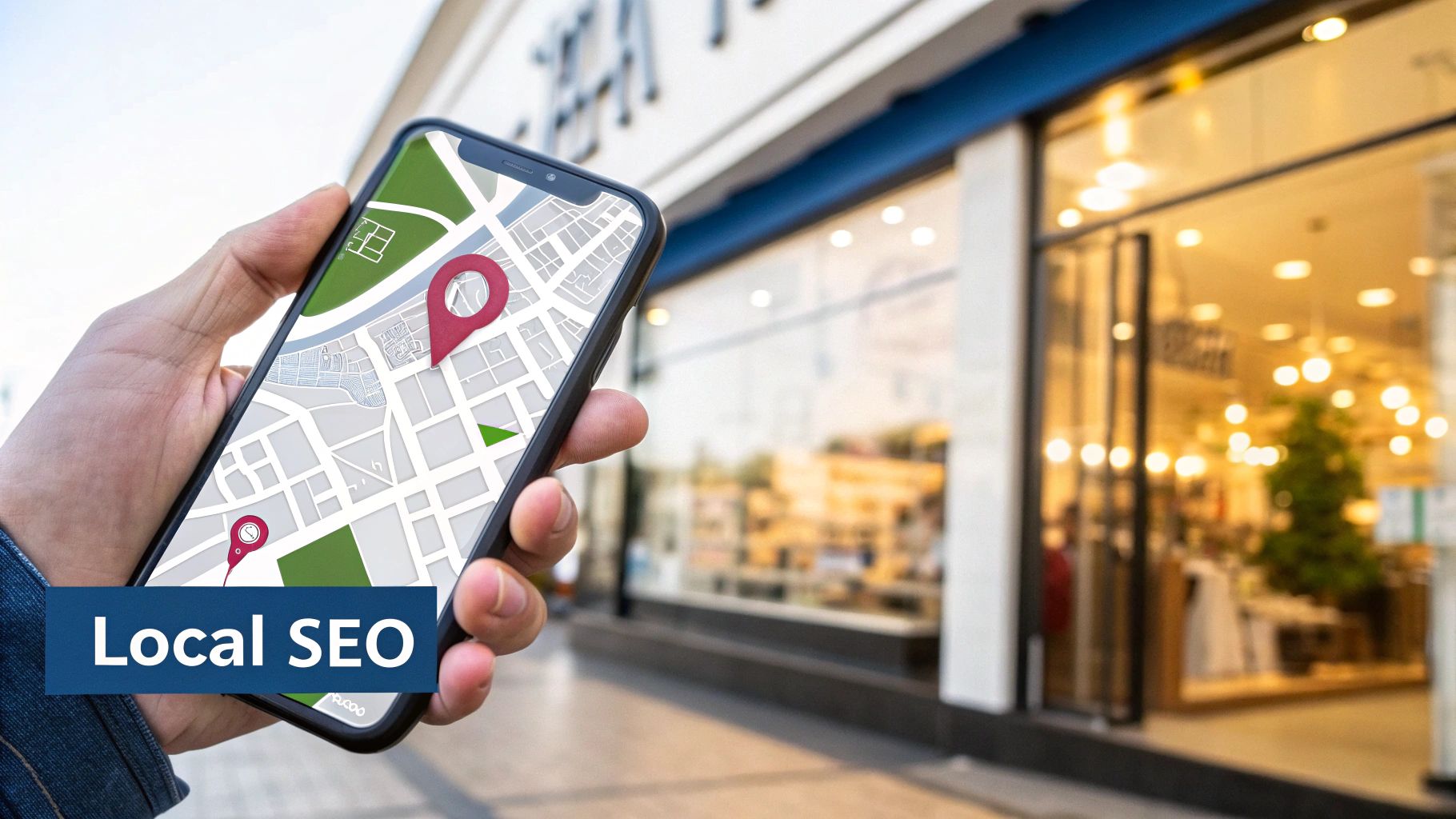
This is one of the most impactful marketing strategies for small businesses because it connects you directly with customers who have a high intent to purchase. For instance, an independent restaurant that optimises its local presence can appear above national chain competitors in local searches, driving immediate foot traffic. A practical example would be a local bookshop ensuring its Google Business Profile lists its opening hours, address, and phone number correctly, and regularly uploads photos of new stock and in-store events.
How to Implement Local SEO Optimisation
- Claim Your Google Business Profile: This is your most important local SEO tool. Fill out every section completely with accurate information, high-quality photos, and regular posts to keep customers updated.
- Encourage and Manage Reviews: Actively ask satisfied customers to leave a review on Google. For example, a hairdresser could have a small card at the till with a QR code linking directly to their Google review page.
- Ensure NAP Consistency: Your Name, Address, and Phone number (NAP) must be identical across all online directories like Yelp, Facebook, and industry-specific sites. Inconsistencies can confuse search engines.
- Create Location-Specific Content: Write blog posts or create service pages that mention local neighbourhoods, landmarks, or events. For example, “The Best Patios for a Summer Drink in the Northern Quarter”.
3. Email Marketing
Email marketing is the practice of building a list of subscribers and sending them targeted messages to nurture relationships, provide value, and drive sales. Unlike social media, you own your email list, giving you a direct and reliable communication channel. For a small business, this is one of the most cost-effective marketing strategies for small businesses, offering an average return of £36 for every £1 spent. It allows you to deliver personalised content straight to your audience’s inbox, keeping your brand top-of-mind.
This direct line to your audience is immensely powerful. A practical example is a local butcher who sends a weekly email with the “Cut of the Week,” a special offer, and a simple recipe to go with it. This provides value, drives sales for a specific product, and keeps customers engaged. On a smaller scale, many local boutiques generate 30-40% of their monthly revenue through well-crafted promotional emails, showing the direct impact this strategy can have on the bottom line.
How to Implement Email Marketing
- Offer a Compelling Lead Magnet: Encourage sign-ups by offering something valuable in return, such as a discount code, a free guide, or exclusive content. A garden centre could offer a free PDF guide on “Planting a Bee-Friendly Garden”.
- Segment Your List: Don’t send the same message to everyone. Group your subscribers based on their behaviour, interests, or purchase history to send more relevant and effective emails.
- Write Engaging Subject Lines: Create curiosity without resorting to clickbait. Aim for 40-50 characters to ensure your subject line is fully visible on mobile devices.
- Focus on a Single Call-to-Action (CTA): Each email should have one clear goal. Whether it’s to “Read the Blog Post” or “Shop the New Collection,” make the next step obvious and easy for your reader to take.
4. Social Media Marketing
Social media marketing involves using platforms like Instagram, Facebook, and LinkedIn to build brand awareness, engage with customers, and drive sales. For a small business, it’s a powerful way to create authentic connections, showcase brand personality, and reach specific audiences where they spend their time. This strategy levels the playing field, allowing you to compete with larger brands by fostering a loyal community.
This is one of the most effective marketing strategies for small businesses because it offers direct access to customers at a minimal cost. For example, a local bakery can use Instagram Stories to show the daily process of making their sourdough bread, creating a behind-the-scenes connection that builds a loyal following. A B2B IT support company could use LinkedIn to share articles about cybersecurity threats, positioning themselves as a knowledgeable expert.
How to Implement Social Media Marketing
- Choose Platforms Wisely: Don’t try to be everywhere. Focus on 2-3 platforms where your target audience is most active. A B2B consultancy will find more value on LinkedIn, whereas a local cafe will thrive on Instagram and Facebook.
- Apply the 80/20 Rule: Dedicate 80% of your content to providing value (tips, entertainment, behind-the-scenes) and only 20% to direct promotion. This builds trust and keeps your audience engaged.
- Post Consistently: Aim for a minimum of 3-5 posts per week on your chosen platforms. Use scheduling tools to maintain a regular presence and post when your audience is most likely to be online.
- Engage Authentically: Social media is a two-way street. Respond to comments and messages promptly, ask questions, and encourage user-generated content by asking customers to share photos with your products. For more guidance on cost-effective approaches, explore these 10 proven low-cost marketing strategies for startups.
- Track and Adapt: Use built-in analytics to see what content performs best. If short-form videos get the most engagement, double down on creating more of them.
5. Referral and Word-of-Mouth Marketing
Referral marketing formalises word-of-mouth by creating a structured programme that incentivises existing customers to recommend your business. This strategy taps into a powerful truth: people trust recommendations from those they know far more than traditional advertising. By creating a remarkable customer experience and making it easy for happy clients to share their success, you can turn your customer base into your most effective sales team.
This is one of the most cost-effective marketing strategies for small businesses because it builds on existing relationships and trust. A practical example is a window cleaning service that offers a 25% discount on the next clean for both the existing customer and the new neighbour they refer. This creates a clear, immediate incentive and can lead to clusters of customers in the same neighbourhood, increasing efficiency.
How to Implement Referral and Word-of-Mouth Marketing
- Ask at the Right Time: The best moment to ask for a referral is when a customer is happiest, such as right after a project’s successful completion, after they leave a positive review, or upon a repeat purchase.
- Make It Effortless: Provide customers with pre-written email templates, unique sharing links, or simple social media prompts. The easier it is to refer someone, the more likely they are to do it.
- Offer Valuable Rewards: Your incentive should be valuable but aligned with your brand. It could be a discount on a future service, a small gift, or early access to new products. Ensure it rewards both the referrer and the new customer.
- Create a Shareable Experience: Go above and beyond in your service delivery. A wedding cake baker who includes a small, complimentary box of anniversary cupcakes creates a memorable moment that clients will tell their friends about.
6. Partnership and Collaboration Marketing
Partnership marketing involves collaborating with complementary businesses to cross-promote, share audiences, and create joint value. For a small business, this strategy provides access to new customer bases without significant advertising spend. It’s about finding non-competing businesses that serve the same target audience and creating a win-win scenario where both parties benefit from the shared exposure.
This is one of the most effective marketing strategies for small businesses because it leverages trust and builds powerful referral networks. For example, a local wedding photographer could partner with venues, florists, and planners. A more specific example would be a local estate agent partnering with a home removals company; they could offer a joint package or simply have a stack of each other’s business cards to hand to clients at the perfect moment.
How to Implement Partnership and Collaboration Marketing
- Identify Your Ideal Partners: Brainstorm businesses that serve your ideal customer but don’t compete directly. A fitness studio could partner with a nutritionist, or a coffee shop could team up with a local bookstore.
- Create a Win-Win Proposition: Your offer must benefit both sides equally. This could be a joint event, a bundled service package, or a simple commission-based referral scheme. Ensure the value exchange is clear from the start.
- Start Small and Formalise: Begin with informal collaborations to test the relationship. Once you find a successful partnership, it’s wise to document expectations. You can get more guidance on running a business partnership to ensure everything is structured properly.
- Focus on Shared Values: Look for partners who have a similar commitment to quality and customer service. A mismatch in values can reflect poorly on your brand and damage your reputation.
7. Video Marketing
Video marketing involves using video to promote your brand, demonstrate products, and engage your audience. In an era where visual content reigns supreme, video allows small businesses to tell compelling stories, build personal connections, and showcase their value proposition in a highly engaging format. From short-form clips on social media to detailed tutorials on YouTube, video can capture attention and drive conversions more effectively than static text or images.
This is a critical component of modern marketing strategies for small businesses because it humanises your brand and simplifies complex information. A practical example is a local bike shop creating a short YouTube tutorial on “How to Fix a Puncture in Under 5 Minutes.” This demonstrates their expertise, builds trust, and attracts local cyclists who may later purchase parts or a new bike from them.
How to Implement Video Marketing
- Start with Your Smartphone: You don’t need expensive equipment to get started. Modern smartphones can shoot high-quality video; focus on good lighting and clear audio, as sound quality is often more important than visual perfection.
- Hook Viewers Immediately: Capture attention within the first 3-5 seconds. Start with a compelling question, a surprising statement, or dynamic movement to stop people from scrolling past your content.
- Add Captions and Subtitles: A significant portion of social media videos are watched without sound. Adding captions ensures your message is received by everyone, dramatically increasing accessibility and engagement.
- End with a Clear Call-to-Action: Tell your viewers what to do next. Whether it’s asking them to visit your website, subscribe to your channel, or leave a comment, a clear call-to-action guides them on their customer journey.
8. Customer Experience and Retention Marketing
Retention marketing prioritises maximising value from existing customers by delivering exceptional experiences. Rather than constantly chasing new leads, this approach focuses on keeping your current customers happy, encouraging repeat purchases, and increasing their lifetime value. Since acquiring a new customer costs significantly more than retaining one, this is a highly cost-effective and profitable strategy for long-term growth. It involves everything from loyalty schemes and personalised communication to proactive customer service.
This is one of the most crucial marketing strategies for small businesses because a loyal customer base creates predictable revenue and powerful word-of-mouth advocacy. A simple but effective example is a local coffee shop’s “buy nine, get the tenth free” punch card, which can often boost repeat business by 30-40%. Another example is a pet supply store that tracks purchase history and sends a reminder email with a 10% discount when a customer is likely running low on their usual brand of dog food.
How to Implement Customer Experience and Retention Marketing
- Map the Customer Journey: Identify every touchpoint a customer has with your business, from their first enquiry to post-purchase follow-up. Pinpoint and fix any areas of friction.
- Implement a Simple Loyalty Programme: Start with something manageable like a points system for discounts, a tiered VIP club, or a basic punch card. The goal is to reward repeat business.
- Personalise Your Communication: Send personalised thank-you emails after a purchase. Acknowledge customer milestones like birthdays or anniversaries with a special offer to show you value their business.
- Gather and Act on Feedback: Regularly survey customers to understand their satisfaction levels. Crucially, show them you are listening by implementing their suggestions and communicating the changes you’ve made.
9. Influencer and Micro-Influencer Marketing
Influencer marketing involves partnering with individuals who have an established, credible audience in your target market to promote your products or services. For small businesses, this doesn’t mean paying for A-list celebrities. Instead, the real power lies with micro-influencers (1,000-100,000 followers), who often have more engaged, niche audiences and are far more affordable. Their followers trust their recommendations, making their endorsements feel authentic and personal rather than like a traditional advertisement.
This is a potent strategy as it leverages pre-built trust. A practical example is a small, ethical skincare brand that sends its new face oil to ten local beauty bloggers with between 5,000 and 15,000 followers. Their authentic reviews and “unboxing” videos can generate more targeted sales than a single, expensive ad campaign. Similarly, many local restaurants see a 20-30% increase in foot traffic after partnering with local food bloggers.
How to Implement Influencer Marketing
- Start Small and Local: Focus on nano (1k-10k followers) and micro-influencers in your niche or local area. Their engagement rates are often higher, and they are more open to partnerships based on gifted products.
- Prioritise Alignment Over Reach: Look for an influencer whose brand values and audience demographics align perfectly with yours. Check their previous content and the authenticity of comments on their posts; a high follower count is meaningless without genuine engagement.
- Create Clear Briefs: Provide clear guidelines on your key messages and objectives, but give the influencer creative freedom to produce content that feels natural to their audience.
- Track Your Results: Use unique discount codes or trackable links for each influencer. This allows you to measure the return on investment directly and identify which partnerships are the most effective for your business.
10. Search Engine Marketing (SEM) and Pay-Per-Click Advertising
Search Engine Marketing (SEM) is the practice of gaining website traffic by purchasing ads on search engines. Unlike SEO, which builds organic visibility over time, SEM, primarily through platforms like Google Ads, offers immediate placement at the top of search results. This allows small businesses to connect with customers at the exact moment they are actively searching for the products or services they offer, delivering highly qualified traffic on demand.
This is one of the most direct marketing strategies for small businesses looking for immediate leads and sales. For example, a local plumber can run a targeted Google Ads campaign to appear instantly when someone searches “emergency plumber near me,” generating high-intent phone calls. Another practical example is a business that sells custom-made curtains running a campaign targeting keywords like “made to measure blackout blinds London,” ensuring they reach customers with a specific need and high purchase intent.
The bar chart below highlights some typical performance benchmarks for SEM campaigns, showing what small businesses might expect in terms of cost and return.

These metrics show that while clicks can be costly, a well-optimised campaign can convert this traffic into valuable customers effectively.
How to Implement SEM and Pay-Per-Click Advertising
- Start Specific: Begin with long-tail keywords (e.g., “handmade leather dog collars in Manchester”) which are less competitive and cheaper than broad terms.
- Use Negative Keywords: Actively add negative keywords (e.g., “-free,” “-jobs”) to your campaigns to stop your ads from showing for irrelevant searches, which saves your budget.
- Create Dedicated Landing Pages: Ensure the page users land on after clicking your ad directly matches the ad’s message and offer. This improves your Quality Score and conversion rates.
- Track Everything: Implement conversion tracking from day one to measure what truly matters, such as leads, sales, or phone calls, not just clicks.
- Leverage Ad Extensions: Use sitelinks, location, and call extensions to make your ads bigger and more informative, which can significantly increase your click-through rate.
Marketing Strategies Comparison Matrix
| Marketing Strategy | Implementation Complexity 🔄 | Resource Requirements ⚡ | Expected Outcomes 📊 | Ideal Use Cases 💡 | Key Advantages ⭐ |
|---|---|---|---|---|---|
| Content Marketing | Medium – requires ongoing content creation and SEO skills | Moderate – time investment or outsourcing for quality content | Long-term trust, organic traffic growth, brand authority | B2B, complex products/services, educated buyers | Cost-effective, builds authority, long-lasting assets |
| Local SEO Optimisation | Medium – requires profile optimisation and review management | Low to Moderate – managing listings and outreach | Increased local visibility, foot traffic, local customer acquisition | Local businesses with physical/location focus | Targets high-intent local customers, builds community trust |
| Email Marketing | Medium – building and segmenting a list, creating campaigns | Low to Moderate – tools and content creation | High ROI, direct engagement, measurable sales and nurture | E-commerce, B2B services, content creators | Highest ROI, personalisation at scale, direct owned channel |
| Social Media Marketing | High – managing multiple platforms and content types | Moderate to High – time and skills for consistent engagement | Brand awareness, engagement, viral reach, customer service | B2C, visual brands, younger demographics | Free to start, humanises brand, highly targeted paid ads |
| Referral & Word-of-Mouth Marketing | Low to Medium – setting up programmes and managing incentives | Low to Moderate – programme maintenance and rewards | High-quality leads, viral growth, low customer acquisition cost | Service businesses, subscriptions, e-commerce | Highest lead quality, pre-qualified prospects, viral potential |
| Partnership & Collaboration Marketing | Medium to High – finding and managing partners, coordination | Low to Moderate – shared resources and efforts | Access to new audiences, credibility, co-created value | B2B, local businesses, complementary offerings | Cost-effective growth, builds credibility, network effects |
| Video Marketing | Medium to High – content creation skills and equipment | Moderate – camera, editing tools, production time | Strong engagement, improved conversions, brand connection | E-commerce, service providers, visual products | High engagement, emotional connection, SEO benefits |
| Customer Experience & Retention Marketing | Medium – requires systemic processes and consistent execution | Moderate – loyalty programmes, personalised communications | Increased lifetime value, predictable revenue, customer advocacy | Businesses with repeat purchases, subscriptions | Most cost-effective, increases customer spend, brand loyalty |
| Influencer & Micro-Influencer Marketing | Medium – research and relationship management | Moderate – compensation varies by influencer tier | Increased social proof, brand credibility, targeted reach | B2C, fashion, food, fitness, younger demographics | Authentic endorsements, high engagement, flexible budgets |
| Search Engine Marketing (SEM) & PPC | High – requires ad setup, management, and optimisation | Moderate to High – ad spend and management tools | Immediate traffic, measurable ROI, targeted leads | Service businesses, e-commerce, B2B lead gen | Instant visibility, precise targeting, scalable budget |
Putting Your Marketing Plan into Action
The journey through these ten marketing strategies for small businesses reveals a powerful truth: there is no single “magic bullet” for growth. Instead, success lies in creating a cohesive, multi-faceted approach that reflects your unique brand, serves your specific audience, and fits within your available resources. From the foundational authority built through Content Marketing and the local visibility gained from Local SEO, to the direct, personalised communication of Email Marketing, each strategy offers a distinct pathway to connect with customers.
We’ve explored how forging genuine community ties through Social Media Marketing and encouraging organic advocacy with Referral Programmes can generate powerful, trusted leads. Likewise, expanding your reach via Partnerships and capturing attention with dynamic Video Marketing can open up entirely new segments of your market. Ultimately, all these efforts are magnified when you prioritise an exceptional Customer Experience, turning one-time buyers into loyal advocates. For those ready to accelerate growth, strategic investments in Influencer Marketing and targeted SEM campaigns can provide a significant, measurable boost.
From Knowledge to Momentum: Your Next Steps
The sheer number of options can feel overwhelming, but the key is to avoid paralysis by analysis. The most effective marketing strategies for small businesses are not necessarily the most complex, but the ones that are executed with consistency and focus. Rather than attempting to implement all ten strategies at once, your immediate goal is to build momentum.
Follow this simple, actionable framework to get started:
- Select Your Starting Point: Review the list and choose one or two strategies that feel most achievable and aligned with your business right now. A local bakery, for instance, might prioritise Local SEO and Customer Retention, while a new e-commerce brand might focus on Social Media Marketing and Micro-Influencers.
- Define a Micro-Goal: Set a small, specific, and measurable objective for the next 30 days. This isn’t about transforming your business overnight; it’s about proving the concept. Examples include: “Publish two blog posts and share them on LinkedIn,” or “Secure one cross-promotional partnership with a local, non-competing business.”
- Measure and Learn: Track your results closely. Did the blog posts drive traffic? Did the partnership generate new leads? Use this data not as a pass-or-fail grade, but as valuable feedback to refine your approach. If something works, do more of it. If it doesn’t, analyse why and pivot.
This iterative process of selecting, acting, and measuring is the engine of sustainable growth. By taking focused, deliberate action, you transform theoretical knowledge into a tangible marketing machine that works tirelessly for your business, building a foundation for long-term success.
Ready to move beyond the list and build a structured, actionable marketing plan? The tools and resources at Grow My Acorn are designed to help UK small business owners turn strategy into reality. Explore our platform at Grow My Acorn to organise your ideas, track your progress, and cultivate sustainable growth.
More Topics

What is invoice factoring: A Clear Guide to Faster Cash Flow
Discover what is invoice factoring and how it unlocks fast cash flow for your business with simple examples and practical steps.

12 Profitable Self Employment Ideas to Start in 2025
Discover 12 practical self employment ideas you can launch this year. Our guide covers startup costs, skills, and

How to Delegate Effectively: Master Your Team Productivity
Discover how to delegate effectively with practical tips to boost team productivity, empower others, and drive better results.

How to Build an Email List from Scrath
Learn how to build an email list with our practical guide. Discover actionable strategies and expert tips to grow an audience that converts.

How to Improve Employee Retention
Discover how to improve employee retention with actionable strategies on leadership, compensation, and culture

Streamlining business processes: Boost efficiency today
Discover how streamlining business processes can unlock efficiency and drive growth with practical, actionable steps.

marketing tips for small business: 5 quick wins
Uncover marketing tips for small business that boost ROI with 5 practical strategies you can implement this week

what is professional indemnity insurance? A quick guide
what is professional indemnity insurance: learn what it covers, who needs it, and how to choose the right PI policy for your business.
10 Actionable Marketing Tips for Small Businesses in 2025
Discover 10 practical marketing tips for small businesses. Boost your growth with budget-friendly strategies for SEO,

10 Profitable Business Ideas UK from Home for 2025
Discover 10 practical profitable business ideas UK from home. This guide covers startup costs, income potential,

What Is a Break Even Analysis Explained
What is a break even analysis? Learn how to calculate it and use this simple tool to make smarter financial decisions for your business.

How to Create a Cash Flow Forecast That Works
Learn how to create a cash flow forecast with this practical guide. We cover predicting inflows, mapping outflows,

How to Write a Business Proposal That Wins Clients
Learn how to write a business proposal that actually wins clients. Offering advice and real-world examples

What Is Equity Dilution for Founders
Understand what is equity dilution and how it impacts your startup. Our guide explains cap tables, funding rounds

How to Conduct Competitor Analysis That Drives Growth
Learn how to register a business in the UK with our practical guide. We cover sole trader and limited company setups

How to Register a Business in the UK Your Complete Guide
Learn how to register a business in the UK with our practical guide. We cover sole trader and limited company setups
12 Best Ways to Advertise Your Business in 2025
12 Best Ways to Advertise Your Business Discover the best ways to advertise your business

Small Business Accounting Basics Made Simple
Master small business accounting basics with our guide. Learn bookkeeping, financial statements, and tax

Business Exit Strategy Planning Done Right
Learn what is a business model canvas and how this one-page tool helps startups visualise, test, and refine

How to Find Business Partners That Actually Fit
Discover essential business advice for startups to thrive. Complete guide from Grow My Acorn

High Street vs Digital Business Banking
Compare High Street vs Digital Business Banking for start-ups. Discover the pros and cons of business banking

10 Crucial Pieces of Business Advice for Startups
Discover essential business advice for startups to thrive. Complete guide from Grow My Acorn

How to Scale a Business The Right Way
Learn how to scale a business with proven, real-world strategies. The complete guide

A Board Meeting Agenda Template That Actually Works
Tired of unproductive meetings? Use our board meeting agenda template to drive focus, ensure compliance

Sole Trader Tax Deductions
Learn what is a business model canvas and how this one-page tool helps startups visualise, test, and refine

How to Build Business Credit for Your UK Business
Learn what is a business model canvas and how this one-page tool helps startups visualise, test, and refine

What Is a Business Model Canvas?
Learn what is a business model canvas and how this one-page tool helps startups visualise, test, and refine

How to Improve Customer Service A UK Business Guide
Discover how to improve customer service with actionable strategies for UK businesses

Dealing with Difficult Clients: Top Strategies for Success
Dealing with difficult clients isn’t about winning arguments. Learn how to deal with difficult clients.

Business Plan Executive Summary Examples: 8 Inspiring Samples
How to professionally prepare your business plan executive summary along with practical examples.

Your Guide to a Business Risk Management Framework
Build a robust business risk management framework with our free online guidance.

How to Improve Cash Flow: Proven Tips for UK Businesses
Learn how to improve cash flow with actionable strategies for UK businesses. Master invoicing, managing expenses

Social Media Marketing for Small Business
Social Media Marketing for Small Business Free Expert Guidance from Grow My Acorn the ultimate free resource
10 Powerful Customer Retention Strategies for 2025
Discover 10 actionable customer retention strategies with real examples. Learn how to boost loyalty,

How to Grow a Business The Right Way
How to Grow a Business The Right Way grow your business the right way with free expert advice

Sole Trader vs Limited Company UK Guide
Choose the right business structure. Understand the differences, benefits and pitfalls. Sole Trader? Limited Company?
How to Start a Business in the UK
How to start a business in the UK – Your handy free expert guide on how to start a business in the UK

How to Protect Your Business with Contracts and Agreements
Learn how to protect your business with contracts and agreements. A practical guide for startups

Taking the Leap: The Ultimate Guide to Hiring Your First Employee
Thinking of hiring your first employee? Take a look at our handy guide to understand when and how to recruit.

10 Proven Low-Cost Marketing Strategies for Startups
10 proven low costs marketing strategies which you can implement today to grow your business.

How Much Does It Really Cost to Start a Small Business
Wondering how much it costs to start a small business in the UK? Discover the real start up expenses for entrepreneurs,
Top 20 Home Based Business Ideas
Looking for the best home based business ideas? Discover 20 profitable ways to start a business from home
The Pros and Cons of Running a Business from Home
The Pros and Cons of running a business from home. Considering running a business from home? Read more here.

The Importance of a Business Plan
See why every start-up needs a business plan, what to include in your business plan and why. Easily draft your business plan with our free guidance.

How to Register a Business Name with Companies House: A Step-by-Step Guide for UK Entrepreneurs
Learn how to register a business name with Companies House in the UK. Step-by-step guide covering name rules, fees, documents, etc

Running a Business as a Community Interest Company
Community Interests Company. Get a detailed view of the advantages and disadvantages of running a community interests company

Running a Business as an LLP
Running a business as an LLP. Get an understanding of the LLP business structure with Grow my Acorn

Running a Limited Company in the UK
Considering forming a limited company. Read our guide to see if the Limited Company is the right business structure

Running a Sole Trader Business
Becoming a sole trader. Read our guide to becoming a sole trader and see if it is the right business structure

Running a Business Partnership
Learn how business partnerships work in the UK. Setup, taxes, liability, agreements, pros & cons
Choosing the Right Business Structure
Discover UK business structures: sole trader, partnership, LLP, Ltd, PLC, CIC & charity. Pros & cons explained