
How to Improve Employee Retention
How to Improve Employee Retention – Improving employee retention isn’t just an HR task—it’s a core business strategy. The trick is to stop reacting to departures and start proactively building a workplace where people genuinely want to stay. This means digging into the real reasons people leave and fixing them with better leadership, fair compensation, and a supportive culture.
Why Your Best People Are Quietly Quitting
It’s easy to see employee turnover as a simple line item on a spreadsheet—a recruitment fee here, a few job adverts there, and some onboarding time. But that view misses the bigger, far more damaging picture. The real cost isn’t just in replacing someone; it’s in the hidden ways their departure silently drains your business.
When a key team member walks out the door, their absence creates a ripple effect. The obvious splash is the recruitment cost, which can hit 1.5-2 times their annual salary. But the waves that follow are far more disruptive.
The True Cost of Losing an Employee
Productivity takes an immediate nosedive. Your remaining team members are forced to pick up the slack, often juggling their own duties with unfamiliar tasks. This isn’t sustainable. Before you know it, burnout becomes a serious risk, morale plummets, and the quality of work starts to suffer. Deadlines get missed, and the staff left behind start to feel overworked and underappreciated.
Imagine a small marketing agency in Manchester. When their lead graphic designer resigns, the direct cost is clear. But the indirect costs quickly pile up:
- Project Delays: A major client campaign grinds to a halt because nobody else has the right design skills or project knowledge. This delay costs the agency a performance bonus.
- Lost Knowledge: The designer was the only one who knew the intricate brand guidelines for a key account. Hours are wasted trying to piece together this institutional knowledge.
- Damaged Morale: The remaining junior designer feels overwhelmed and unsupported. Their engagement plummets, and they start casually scrolling through LinkedIn for new roles.
The most painful losses are often invisible on a balance sheet. You don’t see the cost of a demotivated team, a weakened client relationship, or a project that never reached its full potential.
Connecting Retention to Business Stability
High turnover isn’t just an HR problem; it’s a direct threat to your financial health. Each departure erodes your team’s collective expertise, weakens your culture, and forces you into a constant, expensive cycle of hiring and training.
Retaining your people means protecting your investment in them and ensuring the stability and momentum of your business. Before you can even begin to improve retention, you have to fully grasp that making your company a great place to work is one of the smartest financial decisions you can make. It all begins when you start with good people and lay out the rules from the very beginning.
Uncovering the Real Reasons Employees Leave
To get a real grip on employee retention, you first need to put on your detective hat. You can’t fix a problem you don’t understand, and relying on assumptions about why people are leaving is a surefire way to waste time and money.
It’s easy to guess that people are leaving for more pay. You might react by bumping up salaries across the board, only to find the resignations keep coming. Why? Because the real issue wasn’t money—it was a toxic team dynamic, a lack of recognition, or zero opportunities for growth. Moving past guesswork is the first real step toward a retention strategy that actually works.
Every time an employee walks out the door, it creates a direct financial drain. It’s not just about the cost of hiring a replacement; it’s a cascade of lost productivity and knowledge that hits your bottom line hard.
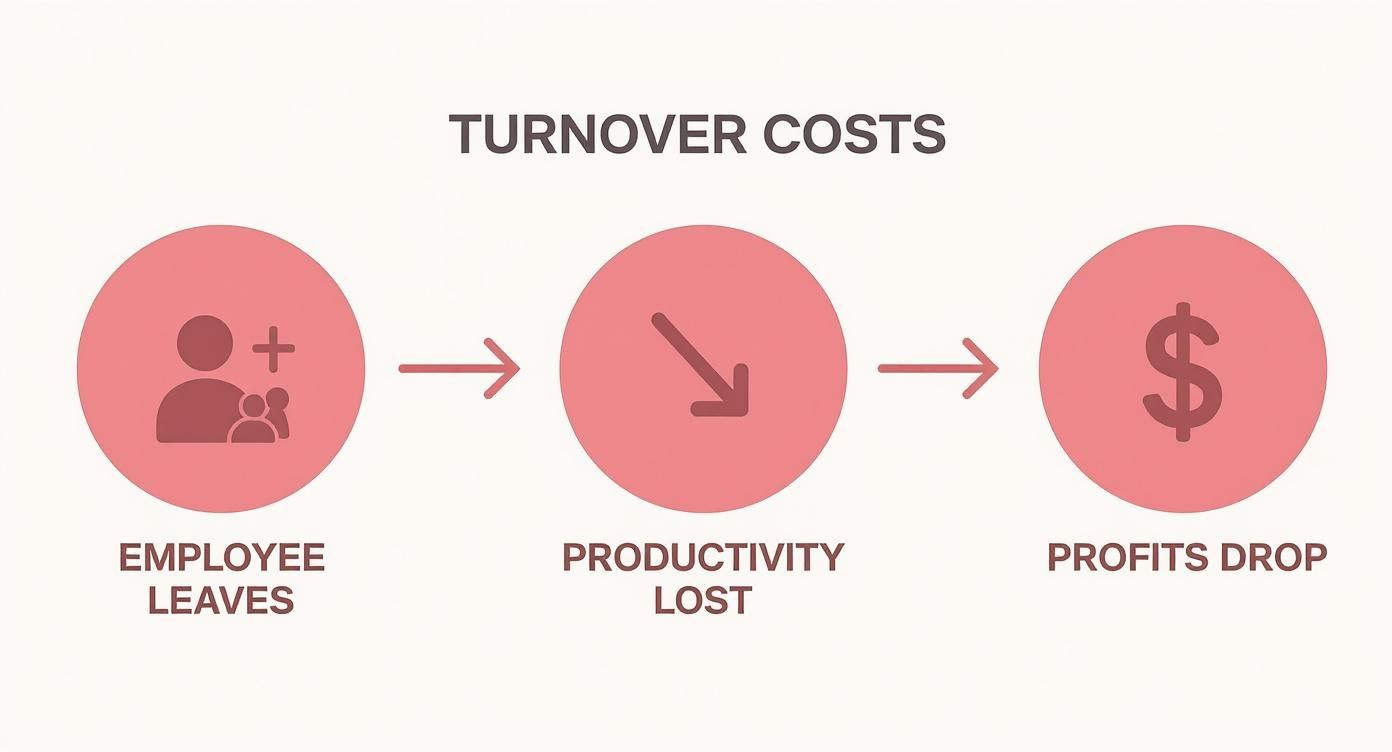
This process isn’t a one-off hit. The true cost is a ripple effect that impacts team morale, project timelines, and customer relationships long after that person is gone.
Go Beyond the Standard Exit Interview
Let’s be honest: traditional exit interviews often fail. Departing employees rarely want to burn bridges, so they give vague, polite answers like “I found a better opportunity” to avoid any awkwardness. To get the real story, you have to create a space where people feel safe enough to be honest.
A simple trick is to have a neutral third party conduct the interview. This could be an external HR consultant or even a senior leader from a completely different department. For example, the Head of Sales could conduct the exit interview for a departing software developer. Taking the direct manager out of the equation often encourages far more candid feedback.
The goal isn’t just to learn why one person is leaving. It’s to uncover systemic issues you can fix for the people who are staying. Every departure is a data point.
Shift your questions from why they are leaving to what their experience was like. Ask things like, “Can you recall a time you felt really motivated and energised here?” and follow it up with, “What was the most frustrating part of your role?” These questions open the door to much richer insights.
Common Turnover Drivers and How to Spot Them
Figuring out the “why” behind turnover requires the right tools. Different problems leave different clues, and knowing where to look is half the battle. This table breaks down common reasons people leave and the best ways to diagnose them in your own business.
| Potential Turnover Driver | Primary Diagnostic Tool | Key Question to Ask |
|---|---|---|
| Poor Management | Stay Interviews | “What could your manager do more of (or less of) to better support you?” |
| Lack of Career Growth | Stay Interviews | “What skills do you want to develop in the next year?” |
| Inadequate Compensation | Anonymous Pulse Surveys | “On a scale of 1–5, how fairly do you feel you are paid for your role?” |
| Toxic Culture or Burnout | Anonymous Pulse Surveys | “Do you feel you can switch off from work outside of your contracted hours?” |
| Lack of Recognition | Exit Interviews | “Did you feel that your contributions were seen and valued here?” |
| Poor Onboarding | Exit Interviews | “Thinking back to your first 90 days, what one thing could we have done better?” |
Using a mix of these tools gives you a much clearer picture. An exit interview might flag a past problem, while a stay interview helps you prevent a future one.
Using a mix of these tools gives you a much clearer picture. An exit interview might flag a past problem, while a stay interview helps you prevent a future one.
Introduce Proactive Stay Interviews
Why wait until someone has one foot out the door before asking for their honest feedback?
Stay interviews are proactive, informal chats with your current, high-performing team members to understand what keeps them happy and engaged. They are arguably one of the most powerful—and most underused—tools for improving employee retention.
These aren’t performance reviews. They’re one-to-one conversations focused entirely on satisfaction and motivation. A practical example could be a manager taking their senior project manager for a coffee and asking these questions in a relaxed setting.
A few powerful questions to get you started:
- “What do you look forward to when you come to work each day?”
- “If you could change one thing about your job, what would it be?”
- “What might tempt you to start looking for another job?”
The answers you get are a real-time roadmap showing you exactly what you need to protect and what you need to fix to keep your best people from even thinking about leaving.
Leverage Anonymous Pulse Surveys
For a broader, real-time read on how your whole team is feeling, you can’t beat simple, anonymous pulse surveys. These are just short, frequent check-ins—maybe 3-5 questions sent out quarterly via a simple tool like Google Forms or Typeform.
The key word here is anonymous. It is absolutely non-negotiable if you want truthful answers.
Here’s a real-world example: a small UK tech firm noticed a dip in morale and assumed it was down to long hours during a busy period. They sent out an anonymous pulse survey. The results revealed the real problem was unclear project ownership, which was causing constant confusion and duplicated work. It was a completely fixable issue that leadership hadn’t even considered.
The secret to making surveys work is to act on the feedback. When people see their input leads to positive change, they’ll trust the process and keep giving you the honest insights you need.
How Strong Leadership Reduces Employee Turnover
It’s an old saying, but it holds true more than ever: people don’t leave companies, they leave managers. While things like pay and benefits absolutely matter, the single biggest influence on an employee’s decision to stay or go is the quality of their direct leader. A great manager is a powerful retention magnet; a poor one will consistently drive your best people away, no matter how great the other perks are.
Improving leadership isn’t about vague motivational posters or generic management courses. It’s about cultivating specific, tangible behaviours that build trust, inspire loyalty, and create an environment where people feel supported enough to do their best work. Without this foundation, any other retention efforts you make will likely fall flat.

Cultivating Psychological Safety
One of a leader’s most critical jobs is to create psychological safety. This simply means building a team environment where people feel safe enough to speak up, share ideas, ask questions, and admit mistakes without fear of blame or humiliation.
When psychological safety is low, your team stays silent. They won’t flag potential problems, offer innovative ideas, or ask for help when they’re struggling. Think about it: a junior developer spots a potential flaw in a project plan but says nothing because their manager publicly criticised another team member for a mistake last week. The flaw goes unnoticed, leading to costly rework and a missed deadline. A leader who fosters psychological safety would have encouraged the feedback, turning a potential disaster into a learning opportunity.
Giving Feedback That Motivates
The way leaders deliver feedback can either build an employee up or tear them down. Vague, infrequent, or overly critical comments leave people feeling confused and demoralised. Great leaders, however, master the art of giving constructive feedback that is specific, timely, and focused on behaviour, not personality.
Instead of saying, “Your presentation was a bit weak,” a strong leader provides actionable advice. “The data you presented was solid, but next time, let’s work on structuring the key takeaways right at the start to grab the audience’s attention more effectively.” This approach shows you’re invested in their growth, not just pointing out their faults.
A leader’s impact on retention is undeniable. Effective leadership directly addresses many of the primary reasons people leave, including feeling undervalued, a lack of development, and poor communication. Investing in your managers is a direct investment in keeping your team intact.
The data backs this up decisively. In the UK, improving leadership quality is one of the most impactful ways to boost employee retention. A recent analysis found that when employees have both a great manager and a great leader, their commitment to stay soars to 94%. However, if the leader is poor—even with a good manager—commitment plummets to just 35%. You can discover more about how leadership quality affects UK attrition rates in the full analysis from Personnel Today.
Developing Emotionally Intelligent Leaders
Emotional intelligence (EI) is the ability to understand and manage your own emotions, as well as recognise and influence the emotions of those around you. For leaders, it’s a non-negotiable skill. An emotionally intelligent manager can sense when a team member is burning out, navigate difficult conversations with empathy, and stay calm under pressure.
This translates into practical, retention-boosting actions every day:
- Practising Self-Awareness: A practical example is a manager noticing they are feeling stressed before a team meeting. Instead of letting that stress create a tense atmosphere, they take five minutes to breathe and start the meeting by calmly acknowledging the pressure everyone is under.
- Showing Empathy: Genuinely trying to understand an employee’s perspective, especially during challenging times.
- Managing Relationships: Building strong, trust-based connections with each member of their team.
Actionable Steps for Better Leadership
You don’t need a massive budget to start developing better leaders. The key is to focus on consistent, small improvements that make a real difference.
- Train New Managers Immediately: Never promote your best individual contributor into a management role without support. Provide foundational training on core skills like delegation, conducting one-to-ones, and giving effective feedback from day one.
- Encourage Peer Coaching: Pair experienced leaders with newer managers. This creates a supportive network where they can share challenges and learn from each other’s real-world experiences. It’s often more effective than a formal course.
- Gather Anonymous Feedback: Use pulse surveys to ask your team specifically about management support. Questions like, “Does your manager provide you with the support you need to succeed?” can provide invaluable, honest insights you won’t get anywhere else.
Ultimately, strong leadership is the cornerstone of any successful strategy for improving employee retention. By focusing on these core behaviours, you can build a team of managers who inspire loyalty and create a culture where your best people choose to stay and grow.
Building a Competitive Compensation and Rewards Strategy
While a positive culture and great leadership are vital, let’s be direct: unfair or uncompetitive pay is often a dealbreaker. If your team feels undervalued financially, they will eventually look elsewhere.
Building a competitive compensation package is a cornerstone of retaining your people. For a small business, this isn’t about trying to outbid large corporations. It’s about being strategic, transparent, and creative. The goal is to create a ‘total rewards’ package where the overall value is compelling, even if the base salary isn’t the absolute highest on the market.
Benchmarking Your Salaries Fairly
Before you can build a fair pay structure, you need to know where you stand. Guessing what the “going rate” is can lead to you either overpaying and straining your budget or underpaying and driving away talent.
Fortunately, there are excellent UK-specific data sources to guide you. Start by using free online tools from sites like Glassdoor, LinkedIn Salary, and Reed.co.uk. These platforms let you benchmark salaries by job title, industry, and location, giving you a realistic salary band to work with.
When you define a role, create a clear salary range for it. For example, a “Mid-Weight Designer” role in Bristol might have a range of £32,000-£38,000 based on your research. This transparency helps manage expectations for both new hires and current staff, preventing the feeling that pay is arbitrary.
Thinking Beyond the Paycheque with Total Rewards
A total rewards strategy acknowledges that people are motivated by more than just their salary. It’s the complete package of pay, benefits, and perks that makes them feel valued. This is where small businesses can truly shine.
You might not be able to match a corporate giant’s salary, but you can compete powerfully in other areas. Consider these practical examples:
- Enhanced Pension Contributions: Offering to contribute 5% to an employee’s pension when the statutory minimum is 3% is a huge, tangible benefit that shows a long-term investment in their future.
- Generous Annual Leave: Providing 28 days of holiday plus bank holidays, instead of the statutory minimum, can be a major differentiator that promotes better work-life balance.
- A Dedicated Development Budget: Allocating a specific annual budget (e.g., £1,000 per person) for courses or conferences proves you are committed to their career growth.
This approach shifts the conversation from “how much do you pay?” to “what is the total value of working here?” It’s a powerful way to frame your offer.
A competitive salary gets people in the door, but a compelling total rewards package makes them want to stay. It shows you care about their financial security, personal time, and professional growth—not just the work they produce today.
Communicating Value and Staying Current
Creating a great package is only half the battle; you also have to communicate its value. Many employees don’t fully realise the monetary value of their benefits. A great way to do this is by providing each team member with an annual ‘total reward statement’ that breaks down their salary, your pension contributions, holiday pay value, and any other perks.
Compensation can’t be a “set it and forget it” task, either. Regularly reviewing pay is crucial for retention. With nearly one in four UK workers planning to leave their jobs, compensation remains a primary driver. Ignoring market shifts is a huge risk, especially when there are over 20,000 monthly searches for ‘resignation letter template’ in the UK. You can find more insights into why UK workers are quitting in this detailed report from WeAreTheCity.
Ultimately, a thoughtful strategy helps you communicate with your employees, motivate them, and reward them in ways that resonate far more deeply than a simple paycheque. This comprehensive approach ensures your team feels genuinely valued, making them far less likely to be tempted by outside offers.
Creating a Culture of Flexibility and Wellbeing
The old-school, 9-to-5 office model is fast losing its appeal. Today’s top talent doesn’t just want a better work-life balance; they expect it. Companies that can’t adapt will find themselves struggling to keep their best people.
Building a culture that genuinely supports flexibility and wellbeing isn’t just a “nice-to-have” perk anymore. It’s a fundamental part of any modern retention strategy. This is about more than buzzwords or superficial gestures. It means embedding real, practical support into your company’s DNA, moving beyond simply letting people work from home to creating a framework of trust where employees feel empowered to manage their work and personal lives without feeling guilty.

Implementing Flexible Work That Actually Works
Flexibility isn’t a one-size-fits-all policy. The real key is finding out what works for both your business and your team. Instead of a rigid rule, think about offering a menu of options that people can adapt to their roles and personal circumstances.
Here are a few popular models that work well in practice:
- Hybrid Models: A common choice where staff split time between the office and home. The most successful setups have clear guidelines. For example, a company might designate Tuesdays and Thursdays as “anchor days” for in-person collaboration, leaving the other days for remote deep work.
- Compressed Hours: This is about working full-time hours but over fewer days, like a four-day week. It’s a hugely powerful perk for anyone who values a longer weekend for family, hobbies, or just life admin.
- Flexitime: This lets employees pick their start and finish times around a set of core hours (e.g., everyone is online between 10 am and 3 pm). For parents needing to do the school run or those with a brutal commute, this simple change can be life-altering.
For instance, a marketing agency in Leeds brought in ‘focus Fridays,’ a simple policy of no internal meetings on Fridays. It gave the team an uninterrupted block of time for creative work and deep thinking, boosting both productivity and morale. They felt trusted to manage their own time—a feeling that translates directly into higher job satisfaction.
Actively Preventing Burnout
A true culture of wellbeing goes way beyond offering a gym membership. It’s about proactively protecting your team from burnout, which is a major driver of turnover. This means setting clear boundaries and, crucially, leading by example.
Start by being clear about expectations for communication outside of standard work hours. If managers are firing off emails at 10 pm, it creates an unspoken pressure for everyone to be constantly online. A practical example of a better approach is using the ‘schedule send’ feature in email clients, so a message written at night arrives during the recipient’s working hours the next morning. This simple policy can make a massive difference.
Wellbeing isn’t an annual initiative; it’s the daily practice of ensuring your team has the time and psychological safety to disconnect and recharge. When people feel their personal time is respected, their loyalty to the company deepens.
You also need to actively encourage your staff to use all of their holiday time. Many dedicated employees feel guilty about taking time off, worrying they’ll fall behind or burden their colleagues. Leaders should not only approve but champion holiday requests, framing them as essential for long-term performance and mental health. When a manager talks positively about their own upcoming holiday, it signals to the whole team that taking a break isn’t just allowed—it’s encouraged.
In the UK, the link between these practices and retention is undeniable. Organisations that provide flexible working and prioritise wellbeing consistently see lower turnover. With high employment and hundreds of thousands of people resigning each quarter, creating a supportive workplace has become a critical competitive advantage. You can read more about these retention trends from the CIPD.
Answering Your Employee Retention Questions
When you’re trying to stop good people from leaving, it can feel like you’re fighting fires on a dozen different fronts. But in my experience, the core issues are usually simpler than they seem. To help you cut through the noise, I’ve answered some of the most common questions I hear from business owners and managers. These are direct, practical answers designed to give you a clear starting point.
What’s the Single Most Effective Way to Reduce Employee Turnover?
If you’re looking for the one thing that will make the biggest difference, it’s this: improve the quality of your line management.
It’s a truth that comes up again and again in every business I’ve worked with. People’s loyalty and commitment are overwhelmingly tied to their direct boss. A great manager can make up for a lot of other shortcomings—a slightly lower salary, a heavy workload—because they provide the support, recognition, and clear direction people need to feel valued and effective.
On the flip side, a poor manager will drive away your best people, no matter how many perks you throw at them. For a small business, this means your best investment is in training your managers. Don’t just send them on a generic course; focus on practical skills. Teach them how to give genuinely useful feedback, how to run a one-to-one meeting that isn’t just a status update, and how to properly support their team’s growth.
How Can We Compete with Larger Companies on Salary?
This is a very real challenge for most small businesses. The trick is to stop trying to win a game you can’t afford to play. Instead of matching the highest salary, you need to offer a more compelling ‘total rewards’ package.
You can absolutely compete, but you have to shift the conversation away from just the payslip and towards the entire employee experience—something bigger corporations often get wrong.
Here are a few practical ways to build a package that punches above its weight:
- Genuine Flexibility: Don’t just say you’re flexible; live it. Offer a hybrid model built on trust, not rigid, top-down policies. For many people, escaping a soul-crushing commute is worth more than a few extra thousand pounds a year.
- Tangible Impact: In a small company, people see the direct results of their work. Make sure you highlight this. Give them a sense of ownership that gets lost in a massive organisation where they’re just a cog in the machine.
- A Closer-Knit Culture: Nurture a supportive, collaborative environment where people feel like they belong, not like they’re just a number on a spreadsheet.
- Meaningful Perks: Think about benefits that don’t break the bank but show you care. An extra day off for birthdays, a budget to create a comfortable home office, or a transparent career map that shows real opportunities for progression.
When you make an offer, frame it around this complete package. It shows you’re investing in the whole person, not just hiring a pair of hands.
How Often Should We Review Our Retention Strategy?
Keeping your team happy is an ongoing effort, not a project you can tick off a list. You should sit down and formally review your retention metrics, feedback, and strategy at least quarterly.
This regular check-in stops small issues from festering into major problems. It gives you the chance to be proactive, reacting to team sentiment or changes in the job market before you start losing people.
In these quarterly reviews, dig into your exit interview notes, look at feedback from pulse surveys, and have honest conversations with your managers. But remember, the day-to-day work of retention never stops. Regular check-ins, visible leadership, and saying “thank you” for a job well done are the things that build a loyal team.
Retention isn’t a task to be completed; it’s a culture to be cultivated. The formal review keeps your strategy on track, but the daily actions of your leaders are what truly make the difference.
What Are the First Three Steps We Should Take Right Now?
Feeling overwhelmed? Don’t try to boil the ocean. A few focused, high-impact steps can build momentum and give you immediate insight.
- Start Listening Immediately: You can’t fix what you don’t understand. Put a simple, anonymous feedback tool in place today. A three-question pulse survey on Google Forms is a fantastic start. Ask what people enjoy most about their work, what frustrates them, and what one thing they would change if they could.
- Focus on Your Managers: Your managers are on the front line of retention. Get them together for a short session focused on their critical role. Give them one or two simple tools they can use straight away, like a better structure for one-to-one meetings or a framework for giving constructive feedback.
- Review Your Pay Structure: You need to know where you stand. Use free online tools to benchmark your current salaries against the market rate for your industry and location in the UK. This isn’t about promising raises tomorrow; it’s about gathering data. You might also want to look at our employer cost of hiring calculator to understand the full financial picture. This data will tell you if your pay is a genuine retention risk.
These three steps will give you a baseline of data, engage your most important leaders, and make sure you’re not falling behind on the fundamentals. From there, you can start building a stronger, more sustainable plan for keeping your best people.
At Grow My Acorn, we believe that building a strong, stable team is the foundation of any successful business. Our resources are designed to give entrepreneurs and company directors the practical advice they need to create a workplace where great people want to stay and grow. Explore more guides and tools at https://growmyacorn.co.uk.
More Topics

What is invoice factoring: A Clear Guide to Faster Cash Flow
Discover what is invoice factoring and how it unlocks fast cash flow for your business with simple examples and practical steps.

12 Profitable Self Employment Ideas to Start in 2025
Discover 12 practical self employment ideas you can launch this year. Our guide covers startup costs, skills, and

How to Delegate Effectively: Master Your Team Productivity
Discover how to delegate effectively with practical tips to boost team productivity, empower others, and drive better results.

How to Build an Email List from Scrath
Learn how to build an email list with our practical guide. Discover actionable strategies and expert tips to grow an audience that converts.

Streamlining business processes: Boost efficiency today
Discover how streamlining business processes can unlock efficiency and drive growth with practical, actionable steps.

marketing tips for small business: 5 quick wins
Uncover marketing tips for small business that boost ROI with 5 practical strategies you can implement this week

what is professional indemnity insurance? A quick guide
what is professional indemnity insurance: learn what it covers, who needs it, and how to choose the right PI policy for your business.

10 Actionable Marketing Tips for Small Businesses in 2025
Discover 10 practical marketing tips for small businesses. Boost your growth with budget-friendly strategies for SEO,

10 Profitable Business Ideas UK from Home for 2025
Discover 10 practical profitable business ideas UK from home. This guide covers startup costs, income potential,

What Is a Break Even Analysis Explained
What is a break even analysis? Learn how to calculate it and use this simple tool to make smarter financial decisions for your business.

How to Create a Cash Flow Forecast That Works
Learn how to create a cash flow forecast with this practical guide. We cover predicting inflows, mapping outflows,

How to Write a Business Proposal That Wins Clients
Learn how to write a business proposal that actually wins clients. Offering advice and real-world examples

What Is Equity Dilution for Founders
Understand what is equity dilution and how it impacts your startup. Our guide explains cap tables, funding rounds

How to Conduct Competitor Analysis That Drives Growth
Learn how to register a business in the UK with our practical guide. We cover sole trader and limited company setups

How to Register a Business in the UK Your Complete Guide
Learn how to register a business in the UK with our practical guide. We cover sole trader and limited company setups

12 Best Ways to Advertise Your Business in 2025
12 Best Ways to Advertise Your Business Discover the best ways to advertise your business

Small Business Accounting Basics Made Simple
Master small business accounting basics with our guide. Learn bookkeeping, financial statements, and tax

Business Exit Strategy Planning Done Right
Learn what is a business model canvas and how this one-page tool helps startups visualise, test, and refine

How to Find Business Partners That Actually Fit
Discover essential business advice for startups to thrive. Complete guide from Grow My Acorn

High Street vs Digital Business Banking
Compare High Street vs Digital Business Banking for start-ups. Discover the pros and cons of business banking

10 Crucial Pieces of Business Advice for Startups
Discover essential business advice for startups to thrive. Complete guide from Grow My Acorn

How to Scale a Business The Right Way
Learn how to scale a business with proven, real-world strategies. The complete guide

A Board Meeting Agenda Template That Actually Works
Tired of unproductive meetings? Use our board meeting agenda template to drive focus, ensure compliance

Sole Trader Tax Deductions
Learn what is a business model canvas and how this one-page tool helps startups visualise, test, and refine

How to Build Business Credit for Your UK Business
Learn what is a business model canvas and how this one-page tool helps startups visualise, test, and refine

What Is a Business Model Canvas?
Learn what is a business model canvas and how this one-page tool helps startups visualise, test, and refine

How to Improve Customer Service A UK Business Guide
Discover how to improve customer service with actionable strategies for UK businesses

Dealing with Difficult Clients: Top Strategies for Success
Dealing with difficult clients isn’t about winning arguments. Learn how to deal with difficult clients.

Business Plan Executive Summary Examples: 8 Inspiring Samples
How to professionally prepare your business plan executive summary along with practical examples.

Your Guide to a Business Risk Management Framework
Build a robust business risk management framework with our free online guidance.

How to Improve Cash Flow: Proven Tips for UK Businesses
Learn how to improve cash flow with actionable strategies for UK businesses. Master invoicing, managing expenses

Social Media Marketing for Small Business
Social Media Marketing for Small Business Free Expert Guidance from Grow My Acorn the ultimate free resource

10 Powerful Customer Retention Strategies for 2025
Discover 10 actionable customer retention strategies with real examples. Learn how to boost loyalty,

How to Grow a Business The Right Way
How to Grow a Business The Right Way grow your business the right way with free expert advice

Proven Marketing Strategies for Small Businesses
Get your marketing strategy off to a flying start with our proven strategies guaranteed to deliver measurable results.

Sole Trader vs Limited Company UK Guide
Choose the right business structure. Understand the differences, benefits and pitfalls. Sole Trader? Limited Company?

How to Start a Business in the UK
How to start a business in the UK – Your handy free expert guide on how to start a business in the UK

How to Protect Your Business with Contracts and Agreements
Learn how to protect your business with contracts and agreements. A practical guide for startups

Taking the Leap: The Ultimate Guide to Hiring Your First Employee
Thinking of hiring your first employee? Take a look at our handy guide to understand when and how to recruit.

10 Proven Low-Cost Marketing Strategies for Startups
10 proven low costs marketing strategies which you can implement today to grow your business.

How Much Does It Really Cost to Start a Small Business
Wondering how much it costs to start a small business in the UK? Discover the real start up expenses for entrepreneurs,
Top 20 Home Based Business Ideas
Looking for the best home based business ideas? Discover 20 profitable ways to start a business from home
The Pros and Cons of Running a Business from Home
The Pros and Cons of running a business from home. Considering running a business from home? Read more here.

The Importance of a Business Plan
See why every start-up needs a business plan, what to include in your business plan and why. Easily draft your business plan with our free guidance.

How to Register a Business Name with Companies House: A Step-by-Step Guide for UK Entrepreneurs
Learn how to register a business name with Companies House in the UK. Step-by-step guide covering name rules, fees, documents, etc

Running a Business as a Community Interest Company
Community Interests Company. Get a detailed view of the advantages and disadvantages of running a community interests company

Running a Business as an LLP
Running a business as an LLP. Get an understanding of the LLP business structure with Grow my Acorn

Running a Limited Company in the UK
Considering forming a limited company. Read our guide to see if the Limited Company is the right business structure

Running a Sole Trader Business
Becoming a sole trader. Read our guide to becoming a sole trader and see if it is the right business structure

Running a Business Partnership
Learn how business partnerships work in the UK. Setup, taxes, liability, agreements, pros & cons
Choosing the Right Business Structure
Discover UK business structures: sole trader, partnership, LLP, Ltd, PLC, CIC & charity. Pros & cons explained