
How to Delegate Effectively
How to Delegate Effectively – Learning how to delegate is about so much more than just offloading tasks. It’s about strategically distributing ownership to empower your team, building a more capable, engaged, and resilient group by trusting them with real responsibility. This shift in mindset transforms delegation from a simple management tactic into a powerful leadership strategy.
Why Effective Delegation Is a Leadership Superpower
Many leaders mistakenly see delegation as a sign of weakness or a loss of control. In reality, it’s one of the most critical skills for scaling your impact and driving business growth.
The temptation to handle everything personally is strong, especially for entrepreneurs who built their business from the ground up. I get it. But this approach quickly creates an operational bottleneck that stifles progress.
When you fail to delegate, you become the single point of failure. Every minor decision, from approving a social media post to finalising a small expense, has to go through you. This not only slows everything down but also sends a clear message to your team: “I don’t trust you.” This lack of trust is incredibly demoralising and leads to disengaged employees who are hesitant to take any initiative.
The True Cost of Doing It All Yourself
The consequences of avoiding delegation ripple far beyond simple inefficiency. They create a chain reaction that can seriously damage team morale and hold back long-term success.
The tangible costs quickly add up:
- Increased Leader Burnout: Juggling too many tasks inevitably leads to exhaustion. When you’re burned out, your ability to focus on high-impact strategic work disappears. For example, you might spend hours formatting an internal report instead of finalising a major client proposal.
- Stifled Team Development: When employees aren’t given opportunities to take on new challenges, their skills stagnate. Their potential remains completely untapped. Imagine a junior marketer who is never allowed to manage a small campaign on their own—they never learn critical project management skills.
- Lower Employee Engagement: A lack of autonomy and trust is a primary driver of disengagement, which directly hits productivity and crushes innovation.
Ultimately, this disengagement will harm your staff retention. Investing in delegation is a key part of learning how to improve employee retention, as it shows your team you value their growth and contributions.
The Financial Impact of Great Delegation
The benefits of mastering this skill aren’t just theoretical; they have a measurable financial upside. In the UK business landscape, leadership effectiveness through delegation has become a critical differentiator.
In fact, leaders skilled at delegation drive 33% more revenue compared to their peers who struggle with this essential skill. This statistic from The Alternative Board underscores why delegation has emerged as a cornerstone of modern UK management.
Delegation is not about abdicating responsibility. It’s about amplifying your impact by empowering others to succeed. The goal is to build a team that can operate effectively and confidently, even when you’re not in the room.
By reframing your perspective, you can see delegation for what it truly is: a strategic investment in your people and your company’s future. It’s about moving from being the primary doer to becoming the primary enabler.
This shift doesn’t mean you lose control. It means you gain leverage, building a stronger, more capable organisation that can thrive and scale far beyond your individual capacity.
Deciding What to Delegate from Your Workload
The first step towards smart delegation isn’t about offloading work—it’s about taking a hard look at your own plate. Before you can hand anything off, you need to get brutally honest about where your time and energy are really going. Most business owners I talk to are shocked when they realise how much of their day is swallowed by low-impact tasks that someone else could easily handle.
This isn’t about guesswork. It’s about creating a practical framework to shift responsibilities strategically. Your goal is to pinpoint the routine, time-consuming jobs that drain your focus but could be fantastic growth opportunities for your team. This is how you clear the decks for the high-value, strategic work that only you can do.
Categorising Your Daily Tasks
One of the most effective methods is to map out your tasks based on two simple factors: how much you enjoy them (or how skilled you are at them) and their impact on the business. This gives you a clear visual of what to keep, what to pass on, and what you might need to scrap altogether.
Try sorting everything on your to-do list into four buckets:
- High Impact, High Skill/Enjoyment (Do): These are your crown jewels. The strategic work where you create the most value and feel most energised. This is where you should be spending the bulk of your time. Example: Negotiating a partnership with a key supplier.
- High Impact, Low Skill/Enjoyment (Delegate): These are prime candidates for delegation. They’re critical for the business but don’t need your specific genius to get done. Handing these off frees you up and helps your team grow. Example: Processing weekly payroll or managing the company’s main social media accounts.
- Low Impact, High Skill/Enjoyment (Delegate or Reduce): Be careful with these. They’re the tasks you might love doing, but they don’t really move the needle. While they feel productive, they can be a trap. These are excellent development tasks for someone else. Example: Designing the graphics for an internal presentation when you have a design team.
- Low Impact, Low Skill/Enjoyment (Eliminate or Automate): These are just pure energy drains. Before you even think about delegating them, ask if they need to be done at all. Many of these are perfect candidates for automation. Example: Manually copying data from a spreadsheet into a report every week.
To get a better handle on ditching inefficient tasks, our guide on streamlining business processes for small businesses is a great place to start.
Creating Your Delegation Hit List
Once your tasks are categorised, you can build your “Delegation Hit List.” This isn’t a random jumble of jobs you hate; it’s a thought-out list of responsibilities ready for a new owner.
Start small. Pick three to five tasks from your “Delegate” categories. Get specific. “Manage social media” is too vague. Break it down into smaller, concrete actions that are easy to hand over.
Practical Examples of Delegable Tasks:
- Admin: Compiling the weekly team rota or handling first-line responses to customer service emails.
- Research: Pulling together initial data for a competitor analysis report or finding statistics for an upcoming presentation.
- Content: Writing the first draft of the weekly internal newsletter or scheduling pre-approved posts on social media.
- Finance: Chasing overdue invoices or preparing initial drafts of expense reports.
- Operations: Ordering office supplies or coordinating with vendors for routine maintenance.
The killer question to ask yourself is: “Am I the only person who can do this?” If the answer is no, it belongs on your delegation list. It’s not about what you can do; it’s about what you should be doing.
This simple flowchart shows the crossroads every leader faces: delegate to drive growth, or hold on to everything and become the bottleneck.
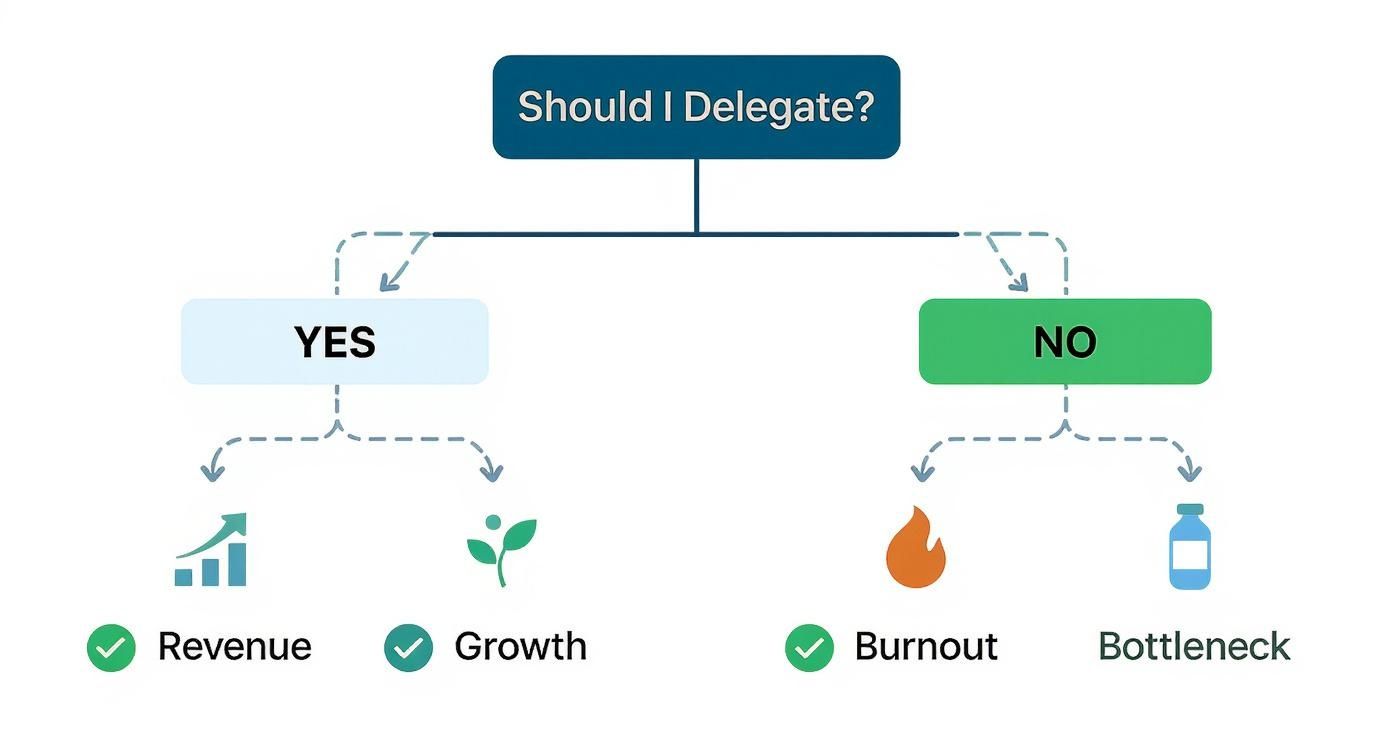
As you can see, the path of delegation leads directly to healthier business outcomes, while the alternative hits your personal well-being and stalls the company.
To make this even more practical, here’s a simple matrix you can use to sort through your workload.
Delegation Decision Matrix
Use this matrix to categorise your daily tasks and identify prime candidates for delegation.
| Task Type | Description | Action to Take | Example |
|---|---|---|---|
| Do (High Impact/High Skill) | Strategic work only you can do. Core to your role and business growth. | Keep & Prioritise | Developing a new product strategy. |
| Delegate (High Impact/Low Skill) | Essential but repetitive tasks that don’t need your unique expertise. | Train & Hand Off | Managing the monthly invoicing process. |
| Reduce (Low Impact/High Skill) | Tasks you enjoy but which don’t create significant value. | Delegate for Development | Designing a simple internal graphic. |
| Eliminate (Low Impact/Low Skill) | Time-wasting activities with little to no return. | Automate or Stop | Manually compiling a report that software can generate. |
By taking the time to audit your tasks this way, you turn delegation from a chore into a powerful strategy. You don’t just get time back—you build a more capable and empowered team ready to tackle bigger challenges. This audit is the foundation of learning to delegate well.
Matching the Right Task to the Right Person
Once you’ve figured out what to delegate, the next big question is who should take it on. This is where a lot of leaders trip up. Giving a task to the wrong person can create more problems than it solves, leading to frustration, missed deadlines, and a breakdown in trust.
Effective delegation is much more than just picking whoever has the most free time. It’s a thoughtful process of matching the right work to the right person to get the best result for everyone involved—the business, and the team member.

Go Beyond Obvious Skills
When you think about who to delegate a task to, your first instinct is probably to choose the person who’s already an expert. While that’s a safe bet for urgent, high-stakes jobs, it’s a massive missed opportunity for team development.
To really get this right, you need to look deeper. Think about your team’s hidden talents, personal interests, and long-term career goals. That quiet person in accounts who loves photography in their spare time? They might be the perfect person to take over creating images for your blog. The junior employee who is meticulously organised could be a natural at project coordination, even if it’s not in their official job description.
When you delegate, you’re not just assigning a task; you’re casting a vote of confidence in someone’s potential. Frame the hand-off as an opportunity for growth, not just a way to clear your plate.
This simple shift turns a routine assignment into a meaningful gesture that builds loyalty and motivation. It shows your team you see them as more than just their current role—you see what they could become.
Delegate for Development
One of the most powerful concepts in leadership is assigning tasks specifically to build new skills. This is known as delegating for development. It involves purposefully giving someone a “stretch assignment”—a task that’s slightly beyond their current comfort zone but totally achievable with the right support.
This is an absolute game-changer for team growth. Instead of just reinforcing existing strengths, you’re actively creating new ones, making your whole team more versatile and resilient.
Here’s a practical example:
- The Old Way: You need the monthly sales analytics report compiled. You automatically give it to Sarah, your data expert, because she’s fast and flawless.
- The Developmental Way: You know Tom, a junior team member, has mentioned wanting to learn more about data analysis. You delegate the report to him, but with a support structure. You ask Sarah to act as a mentor, reviewing his work and answering questions before it gets to you.
In this scenario, Tom gains valuable new skills and a huge confidence boost. Sarah gets to flex her mentoring and leadership muscles. And you? You’re building a more capable team for the future. You’ve just turned a routine task into a multi-faceted development opportunity.
How to Assess Your Team’s Readiness
Matching tasks to people requires a solid understanding of your team’s unique strengths, weaknesses, and goals. If you haven’t already, make time for open conversations about their career ambitions.
Here are a few things to consider for each person:
- Current Skills and Strengths: What are they already brilliant at?
- Developmental Goals: What skills have they said they want to learn?
- Work Style: Do they thrive with creative freedom, or do they prefer clear, structured instructions?
- Current Workload: Can they realistically take on more, or would a new task mean re-prioritising their existing duties?
Getting a handle on these elements is crucial. If you’re building your team from scratch, getting these initial hires right is paramount. For a deeper look, check out our ultimate guide to hiring your first employee, which covers how to spot the skills and attitudes that will best support your business growth.
By taking a more intentional approach to who gets what, you stop seeing delegation as just a time-management hack. You begin to see it for what it truly is: a core part of your leadership strategy for building a smarter, stronger, and more engaged team.
Setting Clear Expectations for Success
Once you’ve matched the right task to the right person, you’ve only won half the battle. So many leaders get this far, only to see the whole thing fall apart.
The single biggest reason delegation fails isn’t a lack of skill or effort from the team member; it’s a lack of clarity from the leader. Ambiguity is the enemy.
When your instructions are vague, you force your team to guess what success looks like. This creates anxiety for them and almost guarantees the final result won’t be what you had in mind, leading to frustration on both sides. To make delegation work, you have to be crystal clear about the outcome from the very beginning.
This doesn’t mean writing a ten-page document for every small task. It’s about creating a simple, repeatable way to communicate what needs doing, why it matters, and what the boundaries are.
Crafting a Simple Delegation Brief
Think of this as a mini-project plan. A good delegation brief is a quick, clear summary that covers the essentials, ensuring everyone is perfectly aligned before a single minute of work begins. It’s your blueprint for a successful hand-off.
The goal isn’t to dictate every single step of the process. You’re defining the destination and providing the map, but you’re letting them drive the car. This empowers your team member to use their own skills and problem-solving abilities to get there.
Your brief should always include these four critical elements:
- The Ultimate Objective (The ‘Why’): How does this task fit into the bigger picture?
- Specific Deliverables (The ‘What’): What exactly needs to be produced or completed?
- Key Constraints (The ‘How’): What’s the budget, deadline, and what resources are available?
- Level of Authority (The ‘Rules’): What decisions can they make on their own?
Let’s look at the difference with a real-world example.
The Vague Request (What Not to Do):
“Can you handle the logistics for the upcoming client event?”
This request is a recipe for disaster. What event? What kind of logistics? What’s the budget? When is it? Who has the final say? The employee is left to fill in all the blanks, which is stressful and wildly inefficient.
The Clear Delegation Brief (What to Do):
“I’d like you to organise the catering for our annual client summit on 20th October. The goal is to create a high-quality experience for our 50 attendees while staying within a £2,000 budget. You have the authority to select the vendor and finalise the menu. Please have a final plan ready for my review by next Friday.”
See the difference? It’s night and day. The team member knows exactly what success looks like and has the autonomy to make it happen.
Vague instructions lead to vague results. Be specific about the outcome you want, not the exact process you would use to get there. This distinction is the key to empowering your team instead of just assigning them chores.
Defining What Success Looks Like
Being clear about the final outcome is the most important part of setting expectations. Don’t just describe the task; describe what a “job well done” actually looks like. You’re giving your team member a target to aim for.
Sometimes, the easiest way to do this is with an example. If you’re delegating the creation of a sales report for the first time, show them a previous one that you consider excellent. This gives them a tangible model to work from and removes all the guesswork.
When you’re defining success, think about these aspects:
- Quality Standards: Is there a specific format to follow? Does it need to be completely error-free? For instance, “The final report must be in the standard company PowerPoint template and double-checked for typos.”
- Tone and Style: If it’s a client-facing document, what tone should it have? Professional? Casual? For instance, “The blog post should have a friendly, conversational tone, similar to our previous articles.”
- Key Performance Indicators (KPIs): Are there specific metrics the task should impact? For instance, “This social media campaign should generate at least 50 new leads.”
Setting the Right Level of Authority
One of the most overlooked parts of delegation is clarifying how much power the person has. This is crucial for building their confidence and preventing them from becoming a bottleneck themselves, constantly coming back to you for permission.
There are generally five levels of authority you can grant:
- Look into this: Ask them to research the topic and report back with the facts. You will make the decision. Example: “Please research three potential venues for the team offsite and bring me the costs and availability.”
- Give me options: Ask them to research and present a few recommended options with pros and cons. You will still make the final call. Example: “Research three venues and tell me which one you think is best and why, then I’ll decide.”
- Give me your recommendation: Ask for their research and their preferred option, but they need your final approval to proceed. Example: “I want you to choose the venue you think is best. Let me know your choice before you book it.”
- Decide and inform me: Allow them to make the decision and then simply let you know what they decided. This keeps you in the loop without you being a roadblock. Example: “You have the authority to choose and book the venue. Just send me a confirmation once it’s done.”
- Decide and act: Grant them full ownership to make the decision and implement it. They don’t need to report back unless there’s a problem. Example: “You are in full control of the venue booking. I trust your judgement.”
Choosing the right level depends on the task’s importance and the team member’s experience. By clearly stating, “You have the authority to decide and act on this,” you’re not just delegating a task; you’re delegating true ownership. This is how you show genuine trust and build the future leaders in your organisation.
Following Up Without Micromanaging Your Team
So you’ve handed off the task. Your job isn’t done—it’s just changed. You’re no longer the doer; you’re the resource. This is the exact point where so many well-meaning leaders stumble into micromanagement, chipping away at the very trust and autonomy they wanted to build.
The secret to a good follow-up isn’t constant pestering. It’s about creating a system of accountability that feels supportive, not stressful. It means swapping out those dreaded, nerve-wracking “just checking in” messages for a structured, pre-agreed rhythm of communication. This is how you create an environment where your team feels they truly own their work and can raise a hand for help without feeling like they’ve failed.

Establish Clear Check-in Points from the Start
The easiest way to kill the temptation to micromanage is to agree on the follow-up process before the work even kicks off. This simple step removes all the guesswork for both of you. Instead of leaving things up in the air, build the check-ins right into the initial briefing.
This isn’t about being rigid; it’s about being respectful. It shows you trust them to get on with it between your chats, but also that you’re invested in the outcome and ready to help clear any hurdles.
Think about the difference here:
- The Micromanager: Sends a daily Slack message asking, “How’s that report coming along?” for a two-week project. This just screams distrust and constantly breaks their concentration.
- The Empowering Leader: During the briefing, says, “This is a two-week project. Let’s schedule a 20-minute catch-up next Friday to review progress and another check-in the following Wednesday before the final deadline.” This signals a partnership and respects their ability to manage their own time.
The whole point of these check-ins isn’t to catch someone out. It’s to create a dedicated, safe space for an open conversation, making it ten times easier for them to ask for guidance when they actually need it.
The Impact on Employee Engagement
Getting this balance right—between supportive follow-up and intrusive oversight—has a massive impact on team morale. The consequences of getting it wrong are pretty stark, especially when you look at the UK workforce. Recent insights on UK employee engagement show that only 10% of UK employees feel genuinely engaged at work. The other 90% are either just going through the motions or are actively disengaged. That’s a huge indicator that many management styles are failing to empower and motivate people.
Trusting your team with real autonomy is one of the most powerful drivers of engagement. When people feel you believe in their ability to deliver without you looking over their shoulder, they invest more of themselves in the work.
By scheduling check-ins, you reinforce the trust you showed from day one. This is a cornerstone of building a team that’s not just productive, but genuinely proactive and engaged.
Focus Your Feedback on Outcomes, Not Methods
When you do have your check-ins, it’s vital to keep the conversation focused on the right things. Fight the urge to dive in and dictate how they should be doing the task. Unless their approach is seriously off-track or about to derail the deadline, your feedback should centre on the progress towards the outcome you both agreed on.
Try framing your questions to encourage ownership and problem-solving:
- “How are we tracking against the final goal we discussed?”
- “Are you hitting any roadblocks I can help clear out of your way?”
- “Is there anything you need from me to hit our next milestone?”
This style of questioning reinforces that they are responsible for the project while positioning you as their coach and supporter. Before long, they’ll start seeing these meetings as a valuable resource, not a stressful interrogation. It’s a subtle but powerful shift that turns a simple update into a real leadership moment.
Your Burning Delegation Questions, Answered
Even when you know why you should delegate, the day-to-day reality can throw up some tricky situations. It’s completely normal. Learning to let go and trust your team is a skill, and like any skill, it takes practice.
Let’s tackle some of the most common questions and sticking points that trip leaders up.
What If My Team Member Makes a Mistake?
First, take a breath. Mistakes are not just inevitable; they’re valuable. Your first job isn’t to assign blame, it’s to manage the outcome.
If it’s a small slip-up, treat it as a coaching opportunity. Instead of just giving them the answer, guide them to figure it out themselves. For example, if a social media post had a typo, ask, “What could we add to our process to catch these things before they go live?” This approach builds problem-solving skills and confidence far better than a quick fix ever could.
For bigger errors, you might need to jump in and help fix it. But afterwards, make time to review the process together. Was there a gap in the brief? Did they need more training? Turning mistakes into improvements for your delegation system is how you win in the long run.
A culture where people feel safe enough to fail is non-negotiable for growth. When your team isn’t terrified of making a mistake, they’re far more willing to take initiative and innovate.
How Do I Delegate to Someone Who Is Already Busy?
This is a classic. Simply dropping another task on an already full plate is a recipe for burnout and resentment. This calls for a conversation about priorities, not just another to-do item.
First, check in with them. Are they genuinely at full capacity, or just feeling the pressure? Sometimes just talking it through reveals they have more room than they thought.
If they really are swamped, bring them into the solution. Frame it collaboratively: “This new project is a big priority for us. Let’s look at your current list—what can we shift, pause, or even drop to make space for this?”
This approach respects their time and empowers them to co-manage the team’s workload. More often than not, this conversation uncovers deeper issues, like an uneven workload across the team or a need for more resources. It’s a fantastic way to gauge your team’s real capacity.
What’s the Difference Between Delegating and Just Assigning a Task?
This is a crucial distinction, and it all comes down to one simple word: ownership.
When you assign a task, it’s transactional. You’re telling someone what to do, but you’re still holding all the responsibility for the outcome.
- Example: “Please order lunch for Tuesday’s meeting.”
When you delegate, it’s transformational. You’re handing over ownership of the result, giving them the authority and trust to see it through.
- Example: “You’re in charge of sorting lunch for Tuesday’s team meeting. The budget is £150, so find a vendor and menu you think everyone will enjoy.”
Assigning is about the ‘what’. Proper delegation is about the ‘why’ and the ‘outcome’, giving them the freedom to figure out the ‘how’.
How Can I Be Sure the Task Will Be Done to My Standards?
Ah, the control freak’s biggest fear. We’ve all been there. But the answer isn’t to micromanage the process; it’s to get crystal clear on the outcome.
Stop worrying about your standards and start defining the project’s success metrics. What does a ‘win’ look like? What are the non-negotiables? If you can, provide examples of what ‘good’ has looked like on past projects.
Your goal isn’t to create a clone who does things exactly your way. It’s to empower someone to achieve the same great result using their own skills and creativity. Granting that autonomy is a huge sign of trust, and it’s absolutely essential for their growth—and your sanity.
Navigating the complexities of business growth requires the right advice at the right time. At Grow My Acorn, we provide entrepreneurs and business leaders with the practical information and guidance needed to succeed. Discover more actionable insights at https://growmyacorn.co.uk.
More Topics

What is invoice factoring: A Clear Guide to Faster Cash Flow
Discover what is invoice factoring and how it unlocks fast cash flow for your business with simple examples and practical steps.

12 Profitable Self Employment Ideas to Start in 2025
Discover 12 practical self employment ideas you can launch this year. Our guide covers startup costs, skills, and

How to Build an Email List from Scrath
Learn how to build an email list with our practical guide. Discover actionable strategies and expert tips to grow an audience that converts.

How to Improve Employee Retention
Discover how to improve employee retention with actionable strategies on leadership, compensation, and culture

Streamlining business processes: Boost efficiency today
Discover how streamlining business processes can unlock efficiency and drive growth with practical, actionable steps.

marketing tips for small business: 5 quick wins
Uncover marketing tips for small business that boost ROI with 5 practical strategies you can implement this week

what is professional indemnity insurance? A quick guide
what is professional indemnity insurance: learn what it covers, who needs it, and how to choose the right PI policy for your business.

10 Actionable Marketing Tips for Small Businesses in 2025
Discover 10 practical marketing tips for small businesses. Boost your growth with budget-friendly strategies for SEO,

10 Profitable Business Ideas UK from Home for 2025
Discover 10 practical profitable business ideas UK from home. This guide covers startup costs, income potential,

What Is a Break Even Analysis Explained
What is a break even analysis? Learn how to calculate it and use this simple tool to make smarter financial decisions for your business.

How to Create a Cash Flow Forecast That Works
Learn how to create a cash flow forecast with this practical guide. We cover predicting inflows, mapping outflows,

How to Write a Business Proposal That Wins Clients
Learn how to write a business proposal that actually wins clients. Offering advice and real-world examples

What Is Equity Dilution for Founders
Understand what is equity dilution and how it impacts your startup. Our guide explains cap tables, funding rounds

How to Conduct Competitor Analysis That Drives Growth
Learn how to register a business in the UK with our practical guide. We cover sole trader and limited company setups

How to Register a Business in the UK Your Complete Guide
Learn how to register a business in the UK with our practical guide. We cover sole trader and limited company setups

12 Best Ways to Advertise Your Business in 2025
12 Best Ways to Advertise Your Business Discover the best ways to advertise your business

Small Business Accounting Basics Made Simple
Master small business accounting basics with our guide. Learn bookkeeping, financial statements, and tax

Business Exit Strategy Planning Done Right
Learn what is a business model canvas and how this one-page tool helps startups visualise, test, and refine

How to Find Business Partners That Actually Fit
Discover essential business advice for startups to thrive. Complete guide from Grow My Acorn

High Street vs Digital Business Banking
Compare High Street vs Digital Business Banking for start-ups. Discover the pros and cons of business banking

10 Crucial Pieces of Business Advice for Startups
Discover essential business advice for startups to thrive. Complete guide from Grow My Acorn

How to Scale a Business The Right Way
Learn how to scale a business with proven, real-world strategies. The complete guide

A Board Meeting Agenda Template That Actually Works
Tired of unproductive meetings? Use our board meeting agenda template to drive focus, ensure compliance

Sole Trader Tax Deductions
Learn what is a business model canvas and how this one-page tool helps startups visualise, test, and refine

How to Build Business Credit for Your UK Business
Learn what is a business model canvas and how this one-page tool helps startups visualise, test, and refine

What Is a Business Model Canvas?
Learn what is a business model canvas and how this one-page tool helps startups visualise, test, and refine

How to Improve Customer Service A UK Business Guide
Discover how to improve customer service with actionable strategies for UK businesses

Dealing with Difficult Clients: Top Strategies for Success
Dealing with difficult clients isn’t about winning arguments. Learn how to deal with difficult clients.

Business Plan Executive Summary Examples: 8 Inspiring Samples
How to professionally prepare your business plan executive summary along with practical examples.

Your Guide to a Business Risk Management Framework
Build a robust business risk management framework with our free online guidance.

How to Improve Cash Flow: Proven Tips for UK Businesses
Learn how to improve cash flow with actionable strategies for UK businesses. Master invoicing, managing expenses

Social Media Marketing for Small Business
Social Media Marketing for Small Business Free Expert Guidance from Grow My Acorn the ultimate free resource

10 Powerful Customer Retention Strategies for 2025
Discover 10 actionable customer retention strategies with real examples. Learn how to boost loyalty,

How to Grow a Business The Right Way
How to Grow a Business The Right Way grow your business the right way with free expert advice

Proven Marketing Strategies for Small Businesses
Get your marketing strategy off to a flying start with our proven strategies guaranteed to deliver measurable results.

Sole Trader vs Limited Company UK Guide
Choose the right business structure. Understand the differences, benefits and pitfalls. Sole Trader? Limited Company?

How to Start a Business in the UK
How to start a business in the UK – Your handy free expert guide on how to start a business in the UK

How to Protect Your Business with Contracts and Agreements
Learn how to protect your business with contracts and agreements. A practical guide for startups

Taking the Leap: The Ultimate Guide to Hiring Your First Employee
Thinking of hiring your first employee? Take a look at our handy guide to understand when and how to recruit.

10 Proven Low-Cost Marketing Strategies for Startups
10 proven low costs marketing strategies which you can implement today to grow your business.

How Much Does It Really Cost to Start a Small Business
Wondering how much it costs to start a small business in the UK? Discover the real start up expenses for entrepreneurs,
Top 20 Home Based Business Ideas
Looking for the best home based business ideas? Discover 20 profitable ways to start a business from home
The Pros and Cons of Running a Business from Home
The Pros and Cons of running a business from home. Considering running a business from home? Read more here.

The Importance of a Business Plan
See why every start-up needs a business plan, what to include in your business plan and why. Easily draft your business plan with our free guidance.

How to Register a Business Name with Companies House: A Step-by-Step Guide for UK Entrepreneurs
Learn how to register a business name with Companies House in the UK. Step-by-step guide covering name rules, fees, documents, etc

Running a Business as a Community Interest Company
Community Interests Company. Get a detailed view of the advantages and disadvantages of running a community interests company

Running a Business as an LLP
Running a business as an LLP. Get an understanding of the LLP business structure with Grow my Acorn

Running a Limited Company in the UK
Considering forming a limited company. Read our guide to see if the Limited Company is the right business structure

Running a Sole Trader Business
Becoming a sole trader. Read our guide to becoming a sole trader and see if it is the right business structure

Running a Business Partnership
Learn how business partnerships work in the UK. Setup, taxes, liability, agreements, pros & cons
Choosing the Right Business Structure
Discover UK business structures: sole trader, partnership, LLP, Ltd, PLC, CIC & charity. Pros & cons explained